Thursday, 27 March 2014

Are You an Effective Communicator?


  Our communication styles are variable a multitude of factors affect our verbal and auditory abilities. Others may judge our communication capabilities by our appearance, what we choose to speak about, and how clearly we speak. Our listen skills can also impact how we are perceived. For example, if others feel that you understand; demonstrative empathetic listening or active listening they will be willing to communicate with you. An issue that may be a barrier to information sharing is our self-awareness of our communication styles.

We may believe that we are effective communicators or be unconfident in our interactions with others. This will be impacted by the public and possibly the subject matter. We may be very competent communicators at home and when speaking to our family and friends. This may not translate to small or large groups discussions. The subject matter is also related to this, as our family may not be interested in the jargon and pedagogical information associated with early education, while our colleagues may not wish to hear about our grocery lists.


While verbal or written output comprises a part of communication, listening skills constitute the other essential elements to information. To be and effective listener, we must understand the audience allowing for others to complete their thoughts; clarify information; and ask questions. Paraphrasing, or repeating with the other person is communicating reinforces understanding or clarifies any issues that were not already discussed. However, listening involves more than our ears. We must look at our speaker, reduce body movement, and avoid interrupting the speaker.


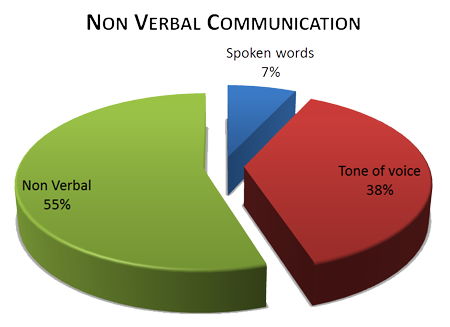
When sending and receiving communications, we must apply the same rules. Unclear messages must be clarified. We must be thoughtful about what we are communicating and in most cases, add additional information to ensure that the receiver has enough information to understand the context of the message, as the nonverbal cues and verbal intonation will not be available for providing additional contest to the reader. Nonverbal communication comprises of 55% body language and 35% tone of voice.


Listed below are two tools that may help you determine your efficacy as a communicator. You may wish to complete lists yourself and then have other complete them with you in mind.
http://www.mindtools.com/pages/article/newCS_99.html


I have also included a link for communicating with the little ones in your life.

Positive Parenting Skills.net.  

contradicting verbal and nonverbal communication


Resources

Communication confusion.  Retrieved from http://www.fiona-campbell.co.uk/blog-details.aspx?hid=19&nid=35


Picture of communication.  Retrieved March 24, 2014 from http://www.mindtools.com/pages/article/newCS_99.htm

Positive Parenting Skills.  Retrieved from March 24, 2014 from http://www.positive-parenting-skills.net/verbal-and-nonverbal-communication.html

Friday, 21 March 2014

Culture and Communciation


Cultural diversity impacts the way we communicate.  The subtle nuances and cultural norms associated with different societies will govern how its citizens interact with each other.  Beyond personal communication styles, age, sex, socioeconomic status and relationship will impact the effectiveness of communication.


We must ensure that we do not take offense to a Middle Eastern man who refuses to shake the hand of a female.  Within the culture, members of the opposite sex do not make physical contact.   In Afghanistan, Iran and some parts of Italy and Greece, a thumb up signal may have the same connotations as the middle finger gesture in North America.   As early educators, who serve multicultural groupings, we must ensure that we are striving to understand the nuances associated with culture diversity.  We must ensure semantics are clear and specific to the situation.  Present language in terms that families and children can understand.  Avoid acronyms and jargon. We must even consider our attire, being courteous and ensure that we do bear too much skin.  Physical contact may also be acceptable or unacceptable with differences in interactions amongst the genders.
We must also try to learn about the cultural, gender and age related norms, while being careful not to stereotype.  Additionally, it is essential that we are responsible and seek external supports in the forms of translation or multicultural brokers when we cannot verbally communicate in a common language.


Teen volunteers enjoy conversation with residents of the Jewish Federation Plaza


Resources


African men. Retrieved from http://www.go2africa.com/africa-travel-blog/12071


O'Hair, D., & Wiemann, M. (2012). Real communication: An introduction. New York: Bedford/St. Martin's.


Saturday, 15 March 2014

Non-verbal Communication- Assumptions


Have you ever watched a television show with the sound turned off or watched a couple across the room, without being able to hear what they are saying?  Are our assumptions correct? Is there a possibility of misunderstanding the intent? Does your familiarity with the character allow you to interpret the nonverbal cues for speech?  In all cases - yes, but we must be cautious. There is a risk of jumping to the incorrect conclusions or responding in an incompatible  fashion.


Our body language conveys more than we may realize.  Subtle physiological factors such as flushing of a face, tilting of a head, pursing of lips may illustrate interest, embarrassment or thought.  Much like verbal communication physical actions can be misinterpreted if taken out of context.  In addition to what we see with our eyes, we must consider the cultural context of what is occurring.  For example, certain gestures such a hand shakes, which are common in North America may not exist or be inappropriate amongst sexes.

Have there been times were you are deep in thought and someone has asked you why you are upset?  Has there been times when you mother smiled at you and you knew that you were in big trouble?  We must be understand that nonverbal communication makes up 55% of what we are saying.  As a result, first impressions really do impact our interactions with others.  Therefore, it is important to maintain an open mind when we are meeting others and during our daily communications to ensure what we are hearing and seeing are truly correlated.  Relying upon one mode of communication only will negatively impact our ability to send and receive messages accurately.


Resources:


O'Hair, D., & Wiemann, M. (2012). Real communication: An introduction. New York: Bedford/St. Martin's.
Pie Chart.  Retrieved March 12, 2014http://www.dennisgingerich.com/wp-content/uploads/2013/02/Non-Verbal-Communication-Chart-Transparent1.png
Nonverbal Communication Web.  Retrieved from https://encrypted-tbn0.gstatic.com/images?q=tbn:ANd9GcT_OnmZsGtpM8ya36bDQejc4TQeMCPK7hXbvP9-yJoQnF9cl4qo

Friday, 7 March 2014

Effective Communication


Effective communicators engage us with their language, actions, and messages. Although communication has a cultural context, there are some personalities, who can, bridge geographic and societal differences; reflecting the world around them and drawing light to issues of importance.

They sell a message and make us want to hear more. The most successful have a high degree of charisma, drawing people to them. When I think about effective communicators within the public eye, two very different personalities come to mind. American businesswoman, advocate and television star, Oprah Winfrey has brought inspiration to so many across the world. Conversely, a second effective communicator is the Dali Lama who also addresses issues of heart and mind within the context of our society.


Oprah is a household name, building a business empire upon her gregarious personality and image. She has engaged audiences with issues related to popular culture, health matters, and social justice. She has an amazing talent to take complex topics and make it part of mainstream communications.

The Dali Lama is an engaging communicator, who approaches the world with a smile and pleasant demeanor. In spite of his meek demeanor and modest appearance, he skillfully addresses complex issues and potential volatile subjects to a wide range of audiences .The Dali Lama is intimately aware of the issue to which he speaks publicly. He address a multitude of issues and draws connections to complex issues by providing examples from contemporary and past times. He engages the listen through a soothing voice which his intonation changes frequently to highlight matters of pertinence.

2013 GSWS: His Holiness The Dalai Lama
http://www.youtube.com/watch?v=nfHREKEGo0c 


Sources

Oprah and Dali Lama.  Retrieved March 7, 2014 from http://mhcyoung.blogspot.ca/2011/08/tgr.html


2013 GSWS: His Holiness The Dalai Lama

http://www.youtube.com/watch?v=nfHREKEGo0c   

Friday, 28 February 2014

Reflections on Diversity


When we think of the child in their world, we must envision their knowledge and experiences as a backpack that the child carries with them as they travel on a different adventure to new worlds. The family prepares the backpack with essential components necessary to venture out into the world; some tools may be useful others may not function outside of the home. As the child reaches many destinations they will pull out resources from their backpack, which will help, them navigate and progress within the new world. Although the children may not always be sure whether these tools will work, they use them to advance farther in their journey. Alternatively, as the child explores, they will discover a friend or a wise adult who will add these new materials will be place into their bag, bringing them to the child's attention. They may also wish to remove tools that may be harmful. Although this journey entails exploration, sometimes the child will meet a barrier; a mental, physical or social risk. The child will need the assistance of adults, friends and some unfamiliar tools to learn how to conquer perceived and real threats. Though there will be times for independent engagement as well as opportunities for everyone to work together. The ultimate objective at the end of each day’s journey is for each child to return to the family, stronger, wiser, and intact with a full backpack.


I have learnt many things about diversity over the curse of the past two months.  I know that it is okay to ask about differences and try to learn from each other.  Not knowing about each other does not constitute discrimination.  However , we do fail by maintaining our sense of privilege or turning our heads when we see inequality.


We have the power and control to make others fell welcomed and supported or rejected and oppressed.  Therefore we must take the route that contributes to the greater good of children and society.

Thank you to my colleagues and professor for the enlightening stories and insightful comments.  You have all been fantastic teachers!

Sources


Roses  Retrieved February 28, 2014 from
http://www.dreamstime.com/stock-images-heart-multicolor-roses-image17166144

Friday, 21 February 2014


When welcoming newcomers into and early education environment it is important to ensure that families and children feel safe and welcomed.  To maintain and inclusive environment, those competing intake processes as well as professions who will be  interacting  with children and  families must be sensitive and responsive to differing racial, cultural, gender, and language needs.  If organizations are unaware of customs or language needs of different culture groups, it is best to do the research in advance.   Local government, multicultural brokers, translation services, colleagues, and families themselves can assist with the education process. Be prepared, but do not stereotype; recognize that all families are different, and try to follow their lead.

Within our environment, we have met many families from Somali. Somalia is the country of origin is located near the Horn of Africa.  According to Wikipedia (2014) many Somali’s also reside in Ethiopia, Yemen and Kenya as well a European and North American countries.  The dominant language is Somali.

This is a groups of people from Africa, who demonstrate follow the teaching of Islam, which prohibit discrimination and outline methods of public and private communication amongst the community members or same and opposite sex.  As Muslims, the women will wear traditional head cover and expectation to cover body part. The members of the community will not engage in activities that do not align with their beliefs.  Therefore, children should not be expected to engage in Halloween themed parties within educational environments. Intergeneration respect is expected amongst family members with equality also expected when in the community.  Women are the primary caregivers, however may also work outside of the home.
The Government of Canada (2009) suggests that a great way to start conversations with new families is to state  "Sidee tahay?" which can be translated to “How are You?”.  Compliments and discussion about family are seen as positive interactions.  Even the males like to receive commentary that they “have nice style”. A sense of humor is valued by the community and respect is provided to those in authority.  However, one must communicate at a respectable distance with a moderate tone of voice.  Voice levels that are too low or too high are negatively received.  Make eye contact, but avoid physical contact.  To be respectful of the culture, ensure that there is not too much exposed skin.  If scheduling meetings, it is important to note that the Somali’s may expect other to be on time, but may not engage in this behavior.

This are is war torn, however, intergeneration respect is taught within the family.  Women are the primary caregivers, however may also work outside of the home.

References

Boys with Guns. Retrieved February 14, 2014 from http://biyokulule.com/June_1990s(2).htm

Government of Canada  (2009).  Centre for Intercultural Learning.  Retrieved February 14, 2014 from http://www.intercultures.ca/cil-cai/ci-ic-eng.asp?iso=vnhttp://www.intercultures.ca/cil-cai/ci-ic-eng.asp?iso=so#cn-1

Mogadishu.  Retrieved February 14, 2014 from http://biyokulule.com/June_1990s(2).htm

Somali Map.  Retrieved February 14, 2014 http://radiomuqdisho.net/?attachment_id=78459


Traditional Hut. Retrieved February 14, 2014 from   http://www.mrsomali.com/

Wikipedia.  (February 7, 2014). Somali people.  Wikimedia Foundation Inc. Retrieved from    http://en.wikipedia.org/wiki/Somali_people

Friday, 14 February 2014

Bias, Prejudice, and Oppression


When people interact with prejudice or bias; world and interpersonal views are negatively impacted. Often culturally insensitive responses result of tradition, misconception or sense of superiority. Understanding this helps us to help ourselves or others to be responsive; reducing stereotypes, improving equity, and eliminating violence. Although culture and traditions reflect ties to our families and may be foundations to many societies, there are engrained beliefs and traditions that are oppressive. Around the world, women continue to struggle to ensure basic rights.


This week a wise person at my workplace commented that her husband was shocked to learn about the treatment of women in India. Atrocities against females in India have recently become reported by the popular press. Women are also subject to torture, molestation, rape, trafficking and death. The New York Times (2013) reports that there are 100,000 incidents of women being burnt to death yearly. 125,000 die from violent injuries. BBC (2011) noted that there were 24,000 reported cases of rape of children, teenagers and women in 2011, and in 94% of the reported cases, victims knew the rapist. 33% of offenders were neighbours or acquaintances while the remainder comprised of family members.

Change cannot occur unless we stand up to change gross human right violations.

More information can be found at Amnesty International


Sources

Derald Wing Sue ( 2013).  Microsaggression.  Retrieved  from http://www.youtube.com/watch?v=h_lQNI9T6vs

Indian women.  Retrieved January 31, 2014 from http://blog.amnestyusa.org/asia/the-worst-place-to-be-a-woman-in-the-g20

New York Times Company .( 2013).India’s New Focus on Rape Shows Only the Surface of Women’s Perils. Retrieved from http://www.nytimes.com/2013/01/13/world/asia/in-rapes-aftermath-india-debates-violence-against-women.html?src=recg&_r=0#Scene_1

BBC ©. ( 2014). How India treats its women. 29 December 2012.  Retrieved from http://www.bbc.co.uk/news/world-asia-india-20863860